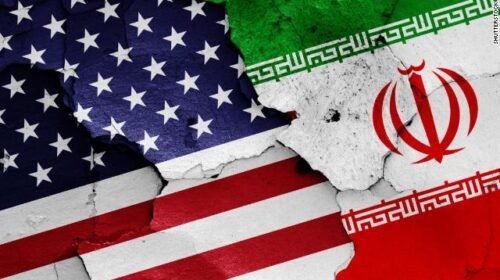
Iran-US agreement – The conflict between US and Iran has finally come to an end as the two agree to a memorandum of understanding which makes the war absolutely over. Some time back this truce seemed distant which has been finally achieved.
A US-Iran agreement to extend the ceasefire between the two countries has been signed and is now in effect. President Donald Trump formally signed the deal which is set to reopen the pivotal Strait of Hormuz.
The 14-point agreement known as a Memorandum of Understanding, says that Iran will never have a nuclear weapon, and also commits a $300bn fund for the “reconstruction and economic development” of the country – although the US is not required to contribute.
Point 1: An end to conflict ‘on all fronts’
The first paragraph notes that the US, Iran and allies will declare an “immediate and permanent” termination of military operations on “all fronts” including Lebanon.
Point 2: Respect for ‘internal affairs’
The text of the document notes that the US and Iran will “respect each other’s sovereignty and territorial integrity” and refrain from interfering in each side’s internal affairs.
Point 3: An extendable 60-day timeline
The US and Iran will commit to negotiating and achieving a final deal in a “maximum” of 60 days, although that timeline could be extended with mutual consent. That 60-day countdown has now begun after the leaders of of the two countries officially signed the MoU.
Point 4: US to end blockade
Once the MoU is signed, the US will begin removing its naval blockade and “any disturbances or impediments” that have been placed on Iranian ports.
The blockade will end fully within 30 days, according to the agreement and the Iranian Ministry of Foreign Affairs. During this time, the vessels the US allows through Iranian ports will be proportional to the traffic being restored by Iran in the Strait of Hormuz.
Point 5: Strait of Hormuz
Part of the agreement notes that, Iran will “make arrangements using its best efforts” to allow safe passage of commercial vessels through the Strait of Hormuz, with no charge.
In the longer-term, the document notes that Iran will work with Oman and other Gulf states to set up a “broader” agreement on how to manage the Strait of Hormuz.
The US believes that Iran will assert its rights “aggressively”, but that the Gulf states would “never” accept a future in which there is a tolling system in place, the official said.
Point 6: Money for Iran reconstruction
The sixth point of the MoU says the US and regional partners will develop a “definitive, mutually agreed plan” worth at least $300bn (£224bn) for reconstruction and economic development in Iran. The final mechanism will be agreed within 60 days of the final deal, and all licenses, waivers and permissions will be granted by the US. However, this does not mean the US will be financially involved.
As an example, the official said that if Iran “behaves”, Emirati authorities could build a power plant in Iran, with US blessing.
Point 7: Sanctions to end
The US will terminate all economic sanctions against Iran, including those included in UN Security Council resolutions and those implemented unilaterally by the US.
The document notes that the schedule will be agreed upon as part of the final deal, but that both sides acknowledge their intentions to “immediately” address the issue in subsequent negotiations.
Point 8: No nuclear weapons
Iran has agreed to not procure or buy a nuclear weapon, and both sides have agreed to deal with the enriched uranium Tehran already has.
The method to manage the material is unclear. The document notes that the mechanism “will be mutually agreed upon” in subsequent talks, but that, at a minimum, it will be “downblended” in place under the supervision of the International Atomic Energy Agency, or IAEA.
Points 9 & 10: A ‘status quo’
The following two parts of the agreement specify that the US and Iran agree to a “status quo” of its nuclear programme until the enriched uranium can be dealt with.
Point 11: Frozen funds
The eleventh point of the document notes that the US “undertakes to make fully available frozen or restricted funds” once the MoU is signed and that procedures will be agreed upon during negotiations.
A US official told reporters on Wednesday that some assets will be released while post-MoU talks continue to reward Iran when it complies with aspects of the agreement, such as beginning to deal with its highly enriched uranium.
Points 12-14: Monitoring and final negotiations
The US and Iran will establish a “mechanism” to monitor the implementation of the MoU and compliance with a future deal, though it is unclear what this will look like in practice.
Then, once the MoU is signed and implementation begins, the US and Iran will start negotations for a final deal.
And finally, the MoU spells out that a final deal will be endorsed by a binding UN Security Council resolution.