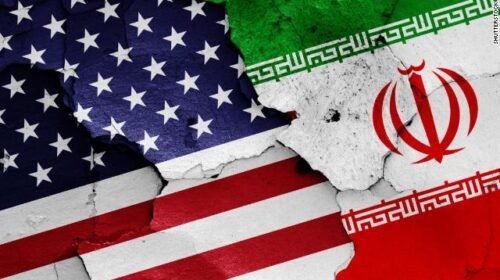
Iran has passed a new proposal to Pakistani mediators in the latest effort to end the war with the US, but Donald Trump said he was not “satisfied” by it.
“Right now, we have talks going on, they’re not getting there,” he told reporters, adding that his options remained “either blast them away or make a deal”.
Trump did not elaborate on what he saw as the latest proposal’s shortcomings but said: “They’re asking for things I can’t agree to.”
In Washington, Trump waved off a Friday deadline imposed by the war powers act, requiring the US president to seek congressional authorisation to continue hostilities beyond 60 days.
In a letter to congressional leaders, Trump claimed that the White House did not need to seek approval from the legislative branch because the ceasefire agreement forged with Iran had in effect paused the 60-day clock – an interpretation disputed by many legal experts. Speaking to reporters, Trump suggested the Vietnam war-era law was “unconstitutional”.
Meanwhile, Iranian state media reported that Tehran handed the offer to Pakistan on Thursday night, to pass on to Washington, though its contents were not immediately clear.
What to expect from the new proposal amid Donald Trump’s stance?
The new proposal had initially been seen by Pakistan’s government as an outcome of its energetic back-channel diplomacy. Islamabad’s role switched in recent days to the lower-profile but urgent task of passing messages between the two sides after the momentum behind direct talks stalled.
Islamabad has said it believes a deal is within reach. But it faces Iranian officials in danger of overplaying their hand and a US administration that is seeking total victory rather than a compromise.
Pakistani officials say they are conscious that it is not only regional peace at stake, but the health of the global economy and the livelihoods of millions of the poorest people in the world – including in Pakistan, whose monthly energy import bill has almost tripled because of the war.
The decision to submit proposals to Pakistan followed a debate inside Iran on whether it should pursue the diplomatic path at all or instead rely on the leverage provided by the ad hoc blockade of the strait of Hormuz. Iranian officials hope Trump will want to end the conflict before his summit with Xi Jinping, the Chinese president, on 14 and 15 May.
Both Iran and the US hardened their positions after the breakthrough of getting them into the same room in Islamabad for an all-night negotiation session in April, the highest-level engagement between the two sides since the 1979 revolution.
According to Tehran, those talks got close to a deal, but the US abruptly walked out. Washington said Iran was not prepared to go far enough. An attempt to engineer a second round in Islamabad last weekend fell apart after the Iranian side refused to meet the US team, which was ready to fly in.
US officials briefed this week that Washington was considering returning to war. Some voices in Iran have expressed frustration that Pakistan has not been able to hold the US to commitments given in the negotiations.
The US Treasury Office warned on Friday that any shipping companies that paid tolls to Iran for passage through the strait of Hormuz, including charitable donations to organisations such as the Iranian Red Crescent Society, would risk punitive sanctions. Tehran has proposed charging fees on vessels passing through the strait, as part of a deal to end the war.
The previous Iranian bid offered to reopen the strait but defer resolving the issue of the country’s nuclear programme. Trump said Iran must commit to not acquiring nuclear weapons, so Tehran would need to tackle this issue to satisfy Washington and set up the possibility of a new round of direct talks.
Iran remains exasperated by the inability of the US to adopt a coherent public position after Trump said he opposed Iran being allowed to enrich uranium even for medical purposes, a concession Iran believed the US delegation had already made.